
When shopping for a used vehicle, most buyers look at mileage, mechanical condition, accident history, and price. But there’s another important factor that can significantly affect a vehicle’s value, safety, and insurability: whether the vehicle has ever been declared a total loss by an insurance company.
Many consumers assume that if a vehicle was previously totaled, it must have a salvage or rebuilt title. Surprisingly, that’s not always the case, especially in Wisconsin.
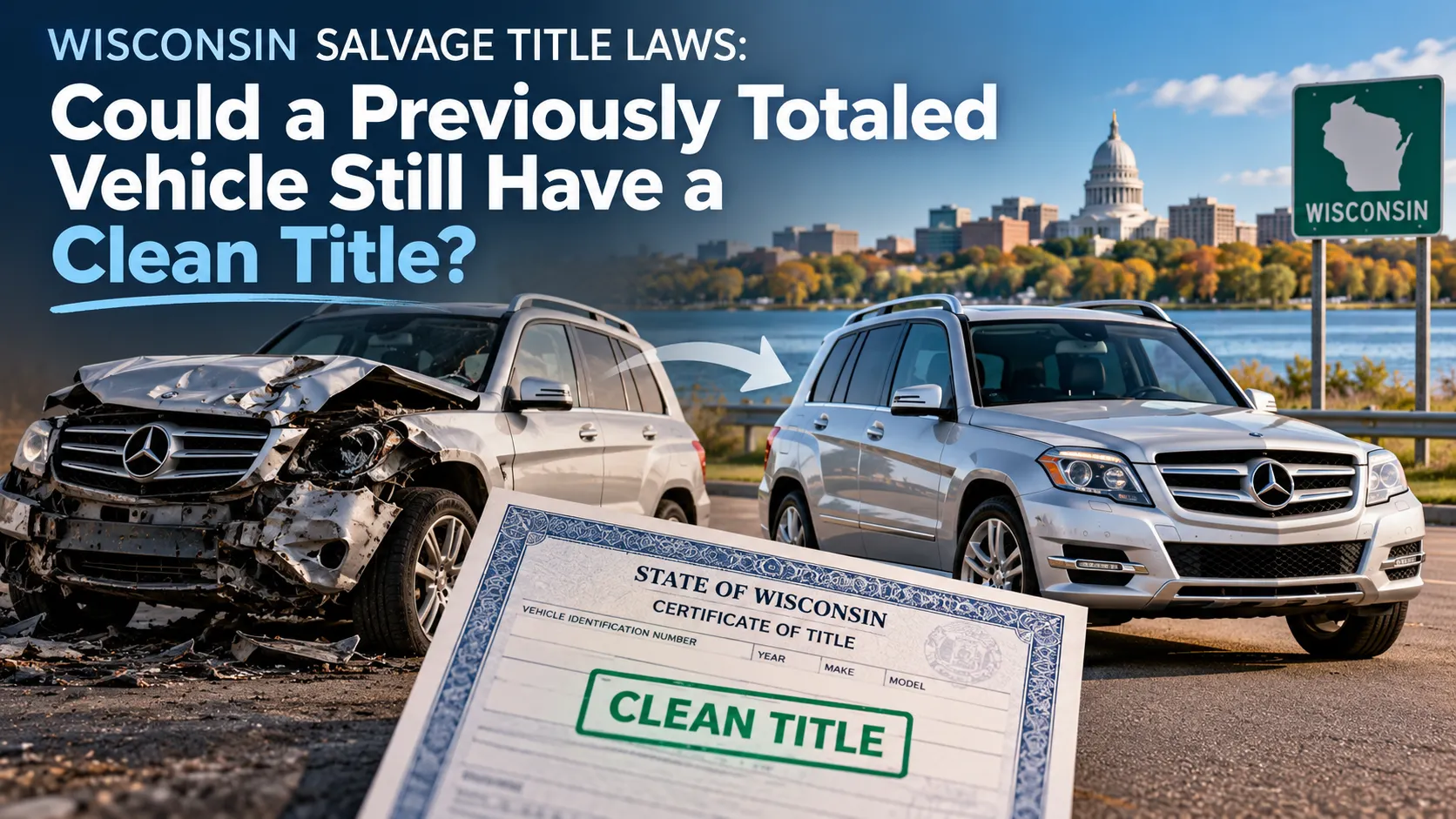
Wisconsin has some relatively lenient salvage-title requirements compared with certain neighboring states. As a result, a vehicle could have sustained substantial damage, been declared a total loss by an insurance company, and still carry a clean Wisconsin title.
Understanding these differences can help consumers avoid expensive surprises.
What Is a Salvage or Branded Title?
A vehicle title is the official document identifying ownership. A title brand provides additional information about a vehicle’s history.
Common title designations include:
- Clean title: No qualifying title brand is recorded. This does not guarantee the vehicle has never experienced serious damage.
- Salvage title: The vehicle meets the state’s legal definition of salvage, generally because of substantial damage.
- Rebuilt salvage title: A previously salvaged vehicle has been repaired and passed the required inspection.
- Flood-damaged title: Indicates qualifying water damage.
- Other title brands: May identify manufacturer buybacks, prior commercial use, or other circumstances.
These distinctions matter because branded vehicles can have lower resale values, financing limitations, and potential insurance restrictions.
Wisconsin’s Seven-Year Rule Makes a Big Difference
Wisconsin’s salvage-title requirements are particularly interesting because they consider both the vehicle’s age and the extent of damage.
Under Wisconsin law, a vehicle generally qualifies for a salvage designation when:
- It is less than seven model years old.
- Its estimated or actual repair costs, whichever is greater, exceed 70% of its pre-accident fair market value.
The second requirement is common among states. The first is what makes Wisconsin different.
For vehicles seven model years old or older, substantial collision damage generally does not trigger Wisconsin’s standard salvage-title requirement.
There are important exceptions, including vehicles previously branded salvage in another state, certain flood-damaged vehicles, and vehicles legally classified as junk.
Nevertheless, the age exemption creates a significant distinction for older used vehicles.
How Does Wisconsin Compare With Neighboring States?
Vehicle-title requirements vary considerably across state lines.
Wisconsin: Uses a greater-than-70% damage threshold combined with its seven-model-year limitation for the standard salvage definition.
Iowa: Generally defines a wrecked or salvage vehicle using repair costs exceeding 70% of pre-damage fair market value, without Wisconsin’s comparable general age exemption. Iowa also has damage-disclosure requirements.
Illinois: Has separate salvage-title and rebuilt-vehicle requirements, including provisions affecting insurer-acquired vehicles and inspection eligibility.
Minnesota: Uses its own salvage and prior-salvage branding rules, including requirements based on vehicle value, age, damage, and insurance involvement.
Michigan: Generally distinguishes salvage vehicles from scrap vehicles using damage thresholds of approximately 75% and 91%, respectively.
The important takeaway is that a vehicle’s title history can be treated differently depending on where it was damaged, insured, or titled.
No single state’s rules should be assumed to apply nationwide.
Example: An Older Mercedes-Benz With Major Damage
Consider a hypothetical 2013 Mercedes-Benz GLK 350.
Before an accident, the vehicle has a fair market value of $8,000. Following the accident, a repair facility estimates $7,000 in damage.
That means the repair costs represent 87.5% of the vehicle’s pre-accident value.
An insurance company might reasonably determine that repairing the vehicle is uneconomical and declare it a total loss.
However, because this Mercedes is more than seven model years old, Wisconsin’s standard age-based salvage requirement generally would not apply solely because of that collision damage.
The vehicle could potentially be repaired and retain an unbranded Wisconsin title, despite having experienced significant damage.
A comparable vehicle in Iowa could face different title and damage-disclosure requirements.
This example demonstrates why a clean title should never be considered proof that a vehicle has not been totaled.
Does a Clean Wisconsin Title Guarantee a Vehicle’s Condition?
Absolutely not.
A clean title simply means the vehicle does not currently carry a qualifying title brand.
It does not guarantee that the vehicle:
- Has never been involved in a serious accident.
- Has never been declared a total loss.
- Has been repaired according to manufacturer specifications.
- Has no structural damage.
- Has functioning airbags and safety systems.
A vehicle may look excellent cosmetically while having a complicated repair history.
For buyers, this makes independent verification extremely important.
What Must Wisconsin Sellers Disclose?
Wisconsin requires sellers to disclose applicable title brands, even when the required brand has not yet been recorded on the title.
Failure to disclose required branding information can result in penalties of up to $5,000.
However, title-brand disclosure and disclosure of every previous accident or insurance total-loss determination are not necessarily the same legal obligation.
A vehicle that does not legally require a salvage brand may still have a significant damage history.
Dealerships can also have additional disclosure obligations, and misrepresentations about a vehicle’s condition may create separate legal issues.
Consumers should ask direct questions and request written answers about prior damage, repairs, and total-loss history.
Can You Get Full Insurance Coverage on a Previously Totaled Vehicle?
Potentially, yes. Most of the time, no. The number of vehicles we have seen this issue with has been trending up which is what prompted me to share this information.
Insurance companies have different underwriting guidelines for previously totaled, salvage, and rebuilt vehicles.
Some insurers may offer liability coverage but restrict comprehensive or collision coverage. Others may consider physical damage coverage after reviewing the vehicle’s condition, documentation, and title history.
A clean Wisconsin title does not automatically guarantee eligibility for full coverage.
Likewise, an insurer’s willingness to provide coverage does not establish that the vehicle is worth the same amount as a comparable vehicle without a significant accident history.
Before purchasing a vehicle with known damage history, buyers should confirm coverage eligibility and understand how a future total-loss settlement might be valued.
Five Steps to Protect Yourself When Buying a Used Vehicle
At Lehmann Insurance Agency, we encourage Wisconsin drivers to take several precautions before purchasing a used vehicle.
- Purchase a vehicle history report. CARFAX or AutoCheck may identify prior accidents, total-loss reports, title changes, and insurance-related events.
- Request an independent inspection. A qualified mechanic or collision specialist can identify structural damage and questionable repairs.
- Review the title history. Look for prior out-of-state branding and inconsistencies in ownership records.
- Compare the vehicle’s price. A previously totaled vehicle may be worth considerably less than an otherwise comparable vehicle without that history.
- Check insurance eligibility before buying. Confirm whether liability, comprehensive, and collision coverage are available.
Final Thoughts: A Clean Title Doesn’t Always Tell the Whole Story
Wisconsin’s seven-model-year rule creates an important distinction between a vehicle’s actual damage history and its legal title classification.
For older vehicles, even substantial collision damage may not result in a Wisconsin salvage designation.
That doesn’t automatically make these vehicles unsafe or poor purchases. Professionally repaired vehicles can provide dependable transportation.
However, consumers deserve to understand what they’re purchasing.
At Lehmann Insurance Agency, we believe informed decisions are essential to protecting both your vehicle and your financial investment.
Whether you’re purchasing a used vehicle, insuring a rebuilt vehicle, or evaluating your current auto insurance coverage, our team can help you understand your options.